

1934 Rolls-Royce 20/25 Saloon

53 Bids Winner - rogerwalkuk
1:23 PM, 08 Dec 2025Vehicle sold
Sold for

£9,740

(inc. Buyer’s Premium)
Winner - rogerwalkuk

Paul's review

Paul Hegarty - Consignment Specialist Message Paul

“ A rare car by one of the premier coach builders. ”

Worthy of some TLC and Recommissioning.

Background

The 20/25 was the second of Rolls-Royce’s pre-war entry level models, and had considerably more get up and go than its predecessor, the 20, thanks to a bigger, more powerful, 3.7-litre engine. 

Built between 1929 and 1936, the 20/25 was tremendously popular, becoming the biggest selling of the inter-war cars built by the world-famous Crewe-based company. 

Its success enabled Rolls-Royce to survive the economic difficulties of the Great Depression years and remain one of world's great brands. 

A total of 3,827 20/25s were produced, of which a staggering 70% are still on the road today. 

An Autocar report in 1931 describes the 20/25 thus: 'Every single feature spells durability, the machine is on a plane altogether superior to the normal style of motor car'. 

All 20/25s were outfitted with custom bodies from legendary coachbuilders such as Park Ward, Vanden Plas, Hooper, Freestone and Webb, Brewster, Gurney Nutting, Thrupp & Maberly, Mulliner, Rippon Bros, Windovers, and Cockshoot. 

The engine was a 3699cc straight-six with overhead pushrod operated valves, featuring a cast-iron block with an aluminium crankcase. A single cast iron cylinder head sat atop the assembly with a single spark plug per cylinder. 

The typically British long stroke design also incorporated a seven main bearing crankshaft with a vibration damper and pressure fed lubrication, with a relief valve feeding the rocker shaft and timing gears. All of which was really very advanced for the time.

Mated to this was a four-speed manual gearbox with synchromesh on third and fourth gears, and a single plate dry clutch. These features, plus servo-assisted brakes on all four wheels, ensured that Rolls-Royce were pretty much leading the way in the development and application of new technology. 

In 1932 shock absorbers and a thermostat-controlled cooling system were introduced. The thermostats operated the radiator air-flow automatically, eliminating the need for the driver to open and close the radiator shutters by hand. 

In 1936 the 20/25 was superseded by the 25/30.

Key Facts

  • Believed to be non-RR Engine and Gearbox
  • Chrome Wire Wheels
  • Ex-Museum Display Car
  • Sliding Roof
  • Older Restoration Requiring Recommissioning
  • Coachbuilt Limousine
  • Recently Retrimmed
  • GED 24
  • 71,000 Miles
  • 3669cc
  • manual
  • Black over Burgundy
  • Beige Leather
  • Right-hand drive
  • Petrol
Vehicle location
THE MARKET HQ, United Kingdom

Background

The 20/25 was the second of Rolls-Royce’s pre-war entry level models, and had considerably more get up and go than its predecessor, the 20, thanks to a bigger, more powerful, 3.7-litre engine. 

Built between 1929 and 1936, the 20/25 was tremendously popular, becoming the biggest selling of the inter-war cars built by the world-famous Crewe-based company. 

Its success enabled Rolls-Royce to survive the economic difficulties of the Great Depression years and remain one of world's great brands. 

A total of 3,827 20/25s were produced, of which a staggering 70% are still on the road today. 

An Autocar report in 1931 describes the 20/25 thus: 'Every single feature spells durability, the machine is on a plane altogether superior to the normal style of motor car'. 

All 20/25s were outfitted with custom bodies from legendary coachbuilders such as Park Ward, Vanden Plas, Hooper, Freestone and Webb, Brewster, Gurney Nutting, Thrupp & Maberly, Mulliner, Rippon Bros, Windovers, and Cockshoot. 

The engine was a 3699cc straight-six with overhead pushrod operated valves, featuring a cast-iron block with an aluminium crankcase. A single cast iron cylinder head sat atop the assembly with a single spark plug per cylinder. 

The typically British long stroke design also incorporated a seven main bearing crankshaft with a vibration damper and pressure fed lubrication, with a relief valve feeding the rocker shaft and timing gears. All of which was really very advanced for the time.

Mated to this was a four-speed manual gearbox with synchromesh on third and fourth gears, and a single plate dry clutch. These features, plus servo-assisted brakes on all four wheels, ensured that Rolls-Royce were pretty much leading the way in the development and application of new technology. 

In 1932 shock absorbers and a thermostat-controlled cooling system were introduced. The thermostats operated the radiator air-flow automatically, eliminating the need for the driver to open and close the radiator shutters by hand. 

In 1936 the 20/25 was superseded by the 25/30.

Video

Overview

This 20/25 was delivered new to the scholar and zoologist Ambrose Harding on July 17th 1934. 

It resided with him at his Cambridgeshire residence, Madingley Hall, until October 1942.

Bodied, we believe by Park Ward, on a limousine chassis, the car passed through a few more British owners before departing for the USA in 1968, where it began life at a motor museum.

It stayed there until 2009, at which point it returned to these shores and started work as a wedding car with Arrow Vintage Cars.

The vehicle is not running at present and will need recommissioning.

We understand that at some point the original Rolls-Royce engine and gearbox were replaced by alternative (possibly Toyota) units.

The subject of an older restoration, the car was at one time dark blue over pale blue and has been repainted in the black over burgundy colour scheme you see today.

The vendor is selling this car as part of a collection owned by his late brother. 

Exterior

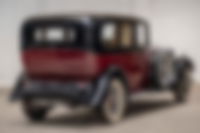
The elegantly rakish limousine bodywork is pretty straight and true from what we can see, and there are no dents, dinks or dings of major significance. 

The brightwork has held up fairly well and there’s only a little light foxing to be found in a few places, primarily on the front bumper.

The paint work is definitely something of a curate’s egg: it’s good in parts, less so in others, and decidedly split, cracked, blistered, peeling or missing elsewhere.

There’s some blistering and bubbling under the paint at the rear of the car; on the bodywork ahead of the windscreen; and on all four wheel-arches, where you’ll also find numerous instances of cracked paint.

There is micro-blistering in evidence on most body panels, and it is particularly apparent on the bonnet. 

All five chromed wire wheels appear to be in very decent condition, as do the grille, mascot, lights and other exterior fixtures and fittings.

Interior

The interior has fared rather better than its exterior counterpart and presents very well throughout – not least because it has evidently been retrimmed at some point in the not-too-distant past.

That work was done to a very high standard with plenty of attention paid to details such as the pull-down blinds, the silk rope pulls, and the leather stowage bag behind the front seats.

The upholstery on the seats is very decent and it’s showing little more than a few creases here and there.

The door cards are broadly OK, too, but the headlining is rather grubby and has ripped in a couple of places.

This is a section of trim hanging down from the carpeted lower section of the o/s/r door card.

The carpets are reasonable, as are the mats, which appear to have been borrowed from a Mercedes-Benz.

The various wood inserts on the door cappings, picnic tables and on and around the dashboard have largely resisted the temptation to crack, fade or shed their lacquer.

The steering wheel, gear lever and other controls all appear to be in order but, as we haven’t started or driven the car, we can’t vouch for their behaviour or efficacy.

Mechanical

Even the most casual of glances will tell you that what you’re looking at under the bonnet is not a Rolls-Royce engine.

What it is exactly, we’re not quite sure, but our best guess is some sort of six-cylinder, twin-cam Toyota engine mated to an equally non-Rolls-Royce gearbox.

We don’t know.

A few spots of what looks like surface rust aside, the chassis and underpinnings look to have plenty of structural integrity, and we’ve seen nothing to make us tut, frown, shake our heads or otherwise question the car’s character or honesty.

History

The car comes with various original build sheets and options lists, plus a history of ownership compiled, presumably, by a previous owner.

There’s also a photocopy of its original buff log book, a wiring diagram, a recent HPI report and a V5C. 

Summary

The exterior needs some largely cosmetic attention, but nothing major we think, and the interior and underpinnings all look really rather impressive.

As a project we think it has the potential to amply repay the time and effort needed to return it to its former glory, perhaps even reuniting it with an appropriate Rolls-Royce engine and gearbox.

As ever, the choice is yours.

We are happy to offer this car for auction with an estimate in the range of £12,000 - £15,000.

Viewing is strongly encouraged, and this lot is located at Bonhams|Cars Online HQ. Viewings are STRICTLY BY APPOINTMENT and we are open weekdays between 10am - 12pm or 2pm - 4pm. To make a booking, please use the ‘Enquire About This Vehicle’ button on the listing. Feel free to ask any questions, or try our ‘Frequently Asked Questions’.

About this auction

Seller

Private: deltra


Viewings Welcome

Viewing is strongly encouraged, and is strictly by appointment. To book one in the diary, please get in contact.

7371d501-16a5-4de6-bfa1-21bb368e91e9/b358832a-d684-494f-b5b5-c2b653261f4e.jpg?optimizer=image&width=650 image

Thinking of selling your Rolls-Royce