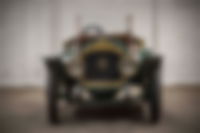

1910 Lorraine-Dietrich 12HP Sport

Click Follow for updates

Auction starts tomorrow

Adam's review

Adam Rose - Consignment Specialist Message Adam

“ There's Unicorns, rocking horse poo, and then there's this... 'Rare' just doesn't cover it. ”

We've spent weeks researching, speaking to colleagues and peers, searching the internet and trawling through libraries, and still we can't value this car - it's that rare.

Background

Based at Luneville in Lorraine, France, De Dietrich et Cie started out as makers of railway locomotives before branching out into automobile manufacture in 1896, by which time the oft-disputed province had been annexed by Germany. 

Designs by Amédée Bollée, Vivinus and Turcat-Méry were licensed at first before the firm commissioned the 20-year-old Ettore Bugatti - an untrained engineer from an artistic family - to come up with some of its own. 

In 1905, the car/aero engine division's name was changed to 'Lorraine-Dietrich' and the Cross of Lorraine adopted as an emblem, emphasising the company's French origins. 

The new firm was managed by Baron de Turkheim, who was keen to develop and push new progressive ideas in the nascent motoring scene. 

Like Napiers and Mercedes, Lorraine-Dietrich's early reputation was built in part on racing, where the marque’s results were impressive, including Charles Jarrott's third in the 1903 Paris–Madrid race and a 1-2-3 in the 1906 Circuit des Ardennes, led by ace works driver Arthur Duray.

Considerable effort was put into racing at this time, often using purpose-built cars fitted with enormous engines.

And we really do mean enormous.

In 1905 a De Dietrich entered the Gordon Bennett Cup race powered by a monstrous 17-litre four-cylinder engine. 

Mercy.

The car finished sixth, recording an average speed of almost 45mph over the 350-mile route. 

After WWI, with Lorraine restored to France, manufacture of cars (and aero engines) recommenced, the principal models of the 1920s being a 12CV (2.3-litre) four and a brace of sixes: 15CV (3.5-litre) and 30CV (6.1-litre). 

Of these, the 15CV B3-6 was the most successful, entering the history books by winning the third and fourth Le Mans 24-Hour races in 1925 and 1926, interrupting Bentley's run of successes. 

Lorraine-Dietrich thus became the first marque to win the famous endurance classic twice and the first to win in consecutive years. 

A clean sweep of the Le Mans podium places is almost unheard of, yet that is what Lorraine-Dietrich achieved in 1926, becoming the first manufacturer ever to do so.
Key Facts

  • Original chassis, engine & gearbox
  • Engine Turns Over & Run
  • Current UK V5 Present
  • Brought over to the UK from Argentina in 2017
  • Restored in the early 00's by renowned restorers Penedo Cars in Buenos Aries, Argentina
  • In current ownership since 2005
  • 15284
  • unknown miles
  • 2100cc
  • manual
  • Green
  • Tan Leather
  • Right-hand drive
  • Petrol
Vehicle location
THE MARKET HQ, United Kingdom

Background

Based at Luneville in Lorraine, France, De Dietrich et Cie started out as makers of railway locomotives before branching out into automobile manufacture in 1896, by which time the oft-disputed province had been annexed by Germany. 

Designs by Amédée Bollée, Vivinus and Turcat-Méry were licensed at first before the firm commissioned the 20-year-old Ettore Bugatti - an untrained engineer from an artistic family - to come up with some of its own. 

In 1905, the car/aero engine division's name was changed to 'Lorraine-Dietrich' and the Cross of Lorraine adopted as an emblem, emphasising the company's French origins. 

The new firm was managed by Baron de Turkheim, who was keen to develop and push new progressive ideas in the nascent motoring scene. 

Like Napiers and Mercedes, Lorraine-Dietrich's early reputation was built in part on racing, where the marque’s results were impressive, including Charles Jarrott's third in the 1903 Paris–Madrid race and a 1-2-3 in the 1906 Circuit des Ardennes, led by ace works driver Arthur Duray.

Considerable effort was put into racing at this time, often using purpose-built cars fitted with enormous engines.

And we really do mean enormous.

In 1905 a De Dietrich entered the Gordon Bennett Cup race powered by a monstrous 17-litre four-cylinder engine. 

Mercy.

The car finished sixth, recording an average speed of almost 45mph over the 350-mile route. 

After WWI, with Lorraine restored to France, manufacture of cars (and aero engines) recommenced, the principal models of the 1920s being a 12CV (2.3-litre) four and a brace of sixes: 15CV (3.5-litre) and 30CV (6.1-litre). 

Of these, the 15CV B3-6 was the most successful, entering the history books by winning the third and fourth Le Mans 24-Hour races in 1925 and 1926, interrupting Bentley's run of successes. 

Lorraine-Dietrich thus became the first marque to win the famous endurance classic twice and the first to win in consecutive years. 

A clean sweep of the Le Mans podium places is almost unheard of, yet that is what Lorraine-Dietrich achieved in 1926, becoming the first manufacturer ever to do so.

Video

Overview

Full disclosure – we’ve never seen a 1910 Lorraine-Dietrich 12hp 2-seater open tourer before. 

And, as far as we can tell from our exhaustive trawling of auction results, archives, Google and any other portal with an opinion, neither has anyone else.

Or, at least, no one who’s ever thought to mention it.

In terms of rare sightings, it’s up there with Lord Lucan, Shergar and the Ark of the Covenant.

So, what do we know?

Well, we believe that the car spent most of its life in Argentina, where it was purchased by Peter Edbrooke in 2005.

He was a passionate car enthusiast and driver, having raced cars well into his 80s, and with a collection that at various times included such cars as a 1936 BMW 328, Lotus 18-Ford Formula 2 car, Lotus 17, Lotus Elite and a rally prepared original Mini…to name but a few.

The chassis, engine, running gear and other mechanicals were present when he purchased the car….but not the body.

To rectify this oversight, he took the car to the esteemed Buenos Aires restorers Jorge and Luis Penedo, who set about fabricating a new body for the car, using open 2-seater touring cars of the era as inspiration. 

‘The Motor Car Red Book – A List Of Motor Cars 1906-1912’ - features the make and the model of the car - thus at least confirming its existence.

Exterior

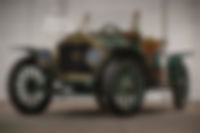
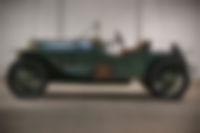
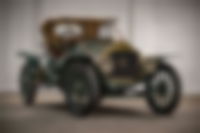
Well, by any measure you care to use in your assessment of this car, the Penedo restoration business - which is globally renowned for the quality and integrity of its work - has evidently done a magnificent job in rebodying the vehicle and ensuring that it is in the first-class dynamic and mechanical condition you see today. 

The bodywork is reassuringly devoid of any dents, dinks, holes, crumples or creases of consequence anywhere that we can see.

The artillery wheels are in very good order, as are the car’s various ancillary items – battery box, horn (currently not working), spare tyre, and lamps.

There are small scratches, scuffs, stone chips and patches of flat paint in various places but, frankly, who cares?

Eagle-eyed observers will note that the (originally acetylene-fuelled, we imagine) headlamps and other lights carry the moniker Blériot, a name rather more famously associated with flying. 

Between 1900-1914, Blériot produced a range of motoring lamps which soon gained a reputation for being the finest available for your motorcar. 

Blériot’s use of solid nickel silver reflectors, solid brass hinges and lugs, and his designs in general led the way in the production of motoring accessories throughout the first decade of the 20th Century.

The year before this car was built, Blériot became the first person in history to fly a powered machine across the English Channel, winning the prize of £1,000 offered by the Daily Mail.

The car’s surprisingly weighty beige canvas hood is in very decent condition and owes its significant mass to the presence of various hardwood and brass struts and fittings. 

It’s pretty much a two-person job to get it up and down unless you’ve been spending too much time in the gym and are routinely in the habit of walking around in public clutching a giant water bottle.

Interior

The interior of this charming car is very much the equivalent of its exterior counterpart as far as condition, quality and delightful aesthetics are concerned. 

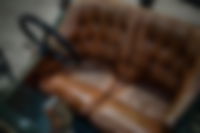
The tan leather seats have enough patina to satisfy even the most incorrigible patina addict.

The steering wheel, other controls, dials, switches, levers and buttons are intact and, as far as we’re aware, fully functional - although we haven’t dared navigate our way through the arcane priming, tweaking and nudging protocols that the car will no doubt demand before it coughs into lusty life and sets forth.

Mechanical

We’ve got no idea what a 12hp Lorraine-Dietrich engine is meant to look like – but what we can see looks fine to us.

It works, we know that, as do the rest of the car’s antiquated mechanical bits and pieces.

The undersides have given us no reason to tut, frown or utter any profanities.

History

Despite being nearly 116 years old, history is a little thin on the ground with this car. 

There is however, a letter, sent to the DVLA from The Veteran Car Company in 2018.

It reads as follows. 

“Dear Sirs,

Re: Lorraine-Dietrich, 1910 12hp model, Chassis Number 15284,

Engine Number 8641

We inspected the 12hp Lorraine-Dietrich detailed above at Woking in Surrey and confirmed that the Chassis Number is 15284 and the Engine Number 8641. In accordance with our own research and rules and from the supporting information

supplied to us we are satisfied that the car is a four cylinder 12 hp model Lorraine-Dietrich made by Sté Lorraine des Anciens Établissements de Dietrich et Cie in 1910.

Veteran Car Company Ltd owns copies of The Motor Car Red Book (a forerunner of

Glasses Guide, extracts enclosed) which confirm that this model Lorraine-Dietrich was only made in 1910. The construction and components of this car match exactly contemporary published information about this model type. Note that although the manufacturer's rather long name was often shortened to de Dietrich (as in the Red Book) the cars were called and badged Lorraine-Dietrich.”

So, there you have it. 

There are copies of Argentinian documents with the car, plus an HPI report.

Summary

This car was built in 1910, nine years after the end of the Victorian era and the same year in which Florence Nightingale, Mark Twain and Leo Tolstoy died. 

And it still starts, goes and stops. 

It is rarer than a steak that’s been shown just a fleeting glimpse of a candle.

We like it very much indeed.

And we think you should, too.

We’re confident to offer this fine car for auction, but you’ll have to decide its value.  We’ve seen them sell for £40,000, and £150,000!

Viewing is strongly encouraged, and this lot is located at THE MARKET, HQ. Viewings are STRICTLY BY APPOINTMENT and we are open weekdays between 10am - 12pm or 2pm - 4pm. To make a booking, please use the ‘Enquire About This Vehicle’ button on the listing. Feel free to ask any questions, or try our ‘Frequently Asked Questions’.

About this auction

Seller

Private
Deposit
7% of the winning bid (minimum £700, maximum £7,000), plus 20% VAT on the Deposit only.


Viewings Welcome

Viewing is strongly encouraged, and is strictly by appointment. To book one in the diary, please get in contact.

a9aa12fa-5312-4abd-bfc4-e217089ed1a0/1477267e-c9ba-4d07-ad84-5b209ac29182.jpg?optimizer=image&width=650 image

Thinking of selling your Lorraine-Dietrich