
Background
Dante Giacosa is possibly one of the most overlooked car designers of the 20th century. Whilst names like Porsche, Piech, and Issigonis are well known and widely celebrated, Giacosa is mostly not – despite his genuinely cool name and rare talent. Born in Rome in 1905 Giacosa put his engineering genius down, surprisingly, to his knowledge of Latin and ancient Greek. He would later claim that this linguistic prowess gave him “a sense of measure and balance without which I could not have done my job.” Unconventional, maybe, but it clearly worked. By 1927 Giacosa was working at Fiat, initially working on huge, multi-cylinder aero engines. Within a couple of years, however, he had become a specialist in small cars.
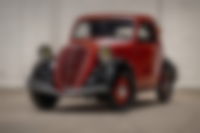
Much like his German peers Giacosa had become involved in a project that had been deemed crucial to the future development of his homeland, no less. Il Duce, Benito Mussolini himself, had directed Fiat to produce a small, affordable car which could accommodate two adults and two children, and which could be bought for just 5,000 Lire. Fiat’s chief designer of the period, Oreste Lardone, quickly came up with a prototype…..which promptly caught fire. Lardone was given his marching orders leaving the way open for Giacosa to shine. And shine he did. Giacosa’s design was originally called the Zero and was both tiny and simple, using a 500cc water-cooled engine, and measuring just over three metres in length. It’s sloped radiator and quirky expression, very quickly earned it the nicknamed “Topolino” — the Italian for Mickey Mouse.
So Fiat were pioneers in diminutive, pre-war peoples’ cars then? Well…..yes…and no. Some sources claim that France’s Simca launched their own version of this diminutive tour de force before Fiat launched theirs. There is a high degree of opacity around the true story, but it is somewhat moot given that Simca was essentially a French manufacturing facility for Fiat at that time. The first Simca “Cinq” rolled out of the Nanterre factory in March 1936 and was essentially identical to the Fiat Topolino. That made for a surprisingly advanced little car which included independent front suspension, a 4-speed gear box, hydraulically controlled drum brakes on all four wheels and a 12-volt electrical system.