1969 Daimler 250 V8

49 Bids Winner - March
1:18 PM, 09 Dec 2025Vehicle sold
Sold for

£10,040

(inc. Buyer’s Premium)
Winner - March

Fraser's review

Fraser Jackson - Consignment Specialist Message Fraser

“ With a photo-documented restoration complimenting the comprehensive history file. ”

Running nicely, a true British classic.

Background

Essentially a rebadged Jaguar MKII fitted with a different engine, the 250 was the first Daimler to be based on a Jaguar, the first to be built without a separate chassis - and the last to have a Daimler engine under the bonnet. 

And, almost unbelievably, it only came about because Stratstone, a Daimler dealer at the time, offered to drop its Volkswagen franchise if the firm designed and built a new medium-sized model to fill a hole in its range…

Try pulling a stunt like that now and see where it gets you.

Powered by the Daimler SP250’s Edward Turner-designed V8, the new powerplant was a whopping 51kgs lighter than the Jaguar unit fitted to the MKII, necessitating revisions to the suspension settings to compensate.

An automatic transmission was standard, with a manual ‘box - and power-steering - being optional extras. Yet, despite the Daimler engine’s lower weight, a top speed of 112mph and a 0-60mph time of 13.6 seconds meant the Daimler was always more of a grand touring car than a racer for the road.

The Daimler 250 lasted from 1962 until 1967, at which point it was replaced by the V8-250 you see here. The changes were subtle and amounted to little more than slimline bumpers and over-riders, twin air-cleaners, and a negative-earth electrical system and alternator.

The interior was also lightly revised with padding added to the instrument panel and door cappings, ventilated leather on the seats, and a split-bench front seat that reclined.

The V8-250 died in 1969 by which time around 17,600 had been built.
Key Facts

  • Good History File
  • re-Chromed
  • Runs Well
  • PIK5741DN
  • 82000 miles
  • 2548cc
  • manual
  • Blue
  • Blue leather
  • Right-hand drive
  • Petrol
Vehicle location
THE MARKET HQ, United Kingdom

Background

Essentially a rebadged Jaguar MKII fitted with a different engine, the 250 was the first Daimler to be based on a Jaguar, the first to be built without a separate chassis - and the last to have a Daimler engine under the bonnet. 

And, almost unbelievably, it only came about because Stratstone, a Daimler dealer at the time, offered to drop its Volkswagen franchise if the firm designed and built a new medium-sized model to fill a hole in its range…

Try pulling a stunt like that now and see where it gets you.

Powered by the Daimler SP250’s Edward Turner-designed V8, the new powerplant was a whopping 51kgs lighter than the Jaguar unit fitted to the MKII, necessitating revisions to the suspension settings to compensate.

An automatic transmission was standard, with a manual ‘box - and power-steering - being optional extras. Yet, despite the Daimler engine’s lower weight, a top speed of 112mph and a 0-60mph time of 13.6 seconds meant the Daimler was always more of a grand touring car than a racer for the road.

The Daimler 250 lasted from 1962 until 1967, at which point it was replaced by the V8-250 you see here. The changes were subtle and amounted to little more than slimline bumpers and over-riders, twin air-cleaners, and a negative-earth electrical system and alternator.

The interior was also lightly revised with padding added to the instrument panel and door cappings, ventilated leather on the seats, and a split-bench front seat that reclined.

The V8-250 died in 1969 by which time around 17,600 had been built.

Video

Overview

‘SOF 171H’ – the number it was first issued with and which led to it being christened ‘Sofi’ – is a Daimler V8-250 fitted with a manual gearbox. 

Which would be unusual enough given the bulk of them left the factory with an automatic gearbox, but there are also letters on file, one from Jaguar and another from the Daimler and Lanchester Owners’ Club, that suggest that it was almost certainly the last manual car ever built.

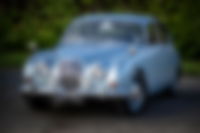
Restored in 1990 and then again in 2019, the factory colour of grey has been changed to the attractive light blue you see here. 

The Daimler has been in the seller’s care since 2014 and is only being sold because he’s lost his storage. 

Exterior

Doesn’t the Daimler’s new colour suit it very well? The photo album that documents its first restoration suggests that that was the point at which it adopted its new colour, with the second and most recent bodywork confirming the adoption.

It’s been bolted together with unusual care too: Imagine having a solid-blue silhouette and drawing in the shutlines with a fine-tipped Sharpie; well, that’s what it looks like in profile.

Trust us when we say that alignment of this quality doesn’t come easy or cheap – and then sit back and be thankful that someone else paid for this level of craftsmanship. 

The steel wheels have been painted the same colour as the coachwork, and this works very well, especially given they’re further graced by a set of very good Daimler-badged chrome wheeltrims. 

Speaking of which, the brightwork – and there is a lot of chrome on a Daimler V8-250 – is all very good, but then there is a hefty bill for rechroming in the 2019 files, plus more for some earlier work back in 1990. 

The most recent work included having the front and rear bumpers and radiator grille rechromed, plus new overriders, so it’s no wonder Sofi sparkles so nicely.

The headlamps are by Lucas, as are the Fog Ranger auxiliary lamps, front indicators and repeater lights, and the rear lamp units and reflectors; a small detail perhaps, but someone chose well, rather than cheaply, when they decided what components to fit. 

The black and silver numberplates are lightly patinated, but that, we think, just adds a touch of authenticity and hints at the registration number’s provenance. 

Finally, the rear tyres are a matching pair of Nankang NC-001 from 2013, while the front rubber is a mismatched pair comprising a Michelin X and a Nankang NC-001.

Of course, there are a few marks here and there including a blemish on the nearside front wing ahead of the mirror, overspray on both nearside rubber door seals, more overspray on all four door latching mechanisms, microblistering to the boot lid, a noticeable scratch to the offside rear sill, and worn seals to the rear window, nearside front quarterlight, and windscreen.

More urgent is the bubble in the paint to the left of the rear numberplate, the bottom of the rear nearside door, and the nearside rear wheelarch. There are also more bubbles along the top of the offside front wing. 

Finally, glue has been smeared along the front of the offside sill; it isn’t harmful, of course, but it is unsightly and looks like rust from a distance.

Interior

If the coachwork still looks pretty fresh, then the dark-blue leather interior is a bit more relaxed, a bit more lived-in, if you like; old money, rather than new, which suits the car’s classic looks down to the ground.

Please don’t think that it is in a bad condition because it isn’t. It merely presents honestly, with a few wrinkles; if you think laughter lines around the eyes of someone you love you won’t be far off the mark. 

The steering wheel is pencil-thin, but then you guide a Daimler through the bends with nothing more than fingertip pressure; muscling it around corners using forearm strength and clenched fists is for drivers of lesser sporting saloons. 

The gearlever and simple black gearknob are equally dainty, and the rubber bellows that sits at its base is in good order.

The door cards are very good, being clean and almost completely free of damage.

A row of toggle switches allow the driver to operate the vehicle without taking their eyes off the road; try that in a modern Jaguar as you navigate through a series of touchscreens…

Instrumentation is via Smiths, and the gauges allow you to monitor road and engine speeds, the distance you have covered, the temperature of the coolant, the pressure of the engine oil, the health of the alternator and battery, the amount of fuel you have left, and the time. 

The boot is vast and nicely painted, even if the trim is a little grubby. Lifting the latter out shows only good metalwork underneath, with only a little surface rust in the spare wheel well. A spare steel wheel and tyre and a jack are provided.

As for the Daimler’s condition, the driver’s seat is, as you’d expect, the most worn. Gently crumpled and a little soft underneath, the leather facing material is still in a decent condition with only a few minor splits, so it could probably be repaired and reused if you would rather maintain the car’s hard-won character. 

The wooden trim is also lightly patinated, with the odd chip and scuff here and there as well as some peeling varnish. It’s not too bad at all though, and we can’t see too many people choosing to put this at the top of their To Do list.

Most of the other problems are equally minor: The headlining has started to sag just a little at the rear and is easing away from the rear window; the offside rear door card has a split in its upper section; the trim on the parcelshelf and C-pillars is warped; the Daimler badge on the steering wheel hub is cracked; the sunvisors have seen better days; the leather is easing away from the top of the rear seat; and the pedal rubbers are worn.

More urgent are the floorpans; lifting the (decent) carpet reveals quite a lot of rust on the nearside front floorpan, some of which is surface-deep but some of which looks to have taken a bit more of a hold. 

Please see the photos for details but be aware we haven’t photographed under every carpet.

Mechanical

Thruxton Jaguar carried out £861-worth of repairs in July 2022, and this included giving the Daimler a full service. This built on the hefty restoration work the seller commissioned in 2019, the receipts for which are in the history file. 

It appears it was previously restored back in 1990 too, and this work wasn’t cheap either, as you can see from those invoices. The history file also contains a photo album that lovingly records Sofi’s revival.

The result of this significant investment is a car that starts well, the V8 engine burbling into life at the press of a button before settling into a steady idle with good oil pressure indicated.

And just listen to that exhaust note! 

It seems odd seeing a V8 under the bonnet of what could be a MKII Jaguar but it’s a nice surprise and the engine and ancillaries are nicely presented being decently clean but not prissy.

If it were ours, we’d be tempted to replace the clear fuel hoses, which have yellowed with age and may well be brittle. This would be an easy job that would provide cheap insurance given the potentially catastrophic effects should they fail.

We also understand that it is not charging the battery, although that battery is new. It’s also had a new master brake cylinder fitted only recently. 

Moving underneath, the underseal has failed in a few places, and we can see a few patches of rust. It doesn’t seem to be extensive, especially given that vulnerable areas such as the spare wheel well and the underside of the four doors all look good, but it will need to be investigated and repaired as a priority.

History

The recent Vehicle History Check is clear, and the history file contains the Operating, Maintenance, and Service Handbook, a brochure, a letter from Jaguar Cars Ltd dated 10th of October 1989 detailing the car’s build specification and date of manufacture, another from the Daimler and Lanchester Owners’ Club confirming its likely status as the last of the manual cars built, and a wealth of old MoT certificates and tax discs.

There are also five-figure’s-worth of invoices for the car’s restoration in 2019 plus others that go back as far as the late 1980s for servicing and restorative work.

The Daimler doesn’t have a current MoT certificate, and while it is exempt by virtue of its age, we would strongly encourage the new owner to have it MoT’d at the earliest opportunity. The cost of an MoT is a small investment when offset against the purchase and upkeep of any classic vehicle, and it gives an independent, third-party assessment of the car’s condition, which not only provides reassurance to the owner (and any subsequent purchasers) but might also be invaluable in the event of a bump when negotiating with the police and any interested insurance companies… 

Summary

A Daimler V8-250 is a great place to be if you’ve a hankering for a Jaguar MKII but don’t fancy paying the Leaper Premium because, weirdly, the market simply doesn’t value them as highly, which means you get the creamy smooth pocket-sized Hemi V8 engine at a discount.

How much of a discount? Well, we estimate this one will sell for somewhere between £8,000 and £12,000 but as it is being offered with no reserve, it’s going to sell from the very first bid.

Viewing is strongly encouraged, and this lot is located at Bonhams|Cars Online HQ. Viewings are STRICTLY BY APPOINTMENT and we are open weekdays between 10am - 12pm or 2pm - 4pm. To make a booking, please use the ‘Enquire About This Vehicle’ button on the listing. Feel free to ask any questions, or try our ‘Frequently Asked Questions’.

About this auction

Seller

Private: Derek250 V83798


Viewings Welcome

Viewing is strongly encouraged, and is strictly by appointment. To book one in the diary, please get in contact.

1d7a6db6-cc7a-456f-a95e-d41fc1d704bb/783a1980-6295-45cc-bd52-8dba75e0c180.jpg?optimizer=image&width=650 image

Thinking of selling your Daimler